-
Table of Contents
Bioavailability of Turinabol: Oral vs Injectable Comparison
Turinabol, also known as 4-chlorodehydromethyltestosterone, is a synthetic anabolic androgenic steroid (AAS) that was developed in the 1960s by East German scientists for use in their Olympic athletes. It is a modified form of testosterone with an added chlorine atom at the fourth carbon position, which gives it a unique chemical structure and properties. Turinabol is known for its ability to increase muscle mass, strength, and athletic performance, making it a popular choice among bodybuilders and athletes. However, there has been much debate about the bioavailability of turinabol and whether the oral or injectable form is more effective. In this article, we will explore the pharmacokinetics and pharmacodynamics of turinabol and compare the bioavailability of the oral and injectable forms.
Pharmacokinetics of Turinabol
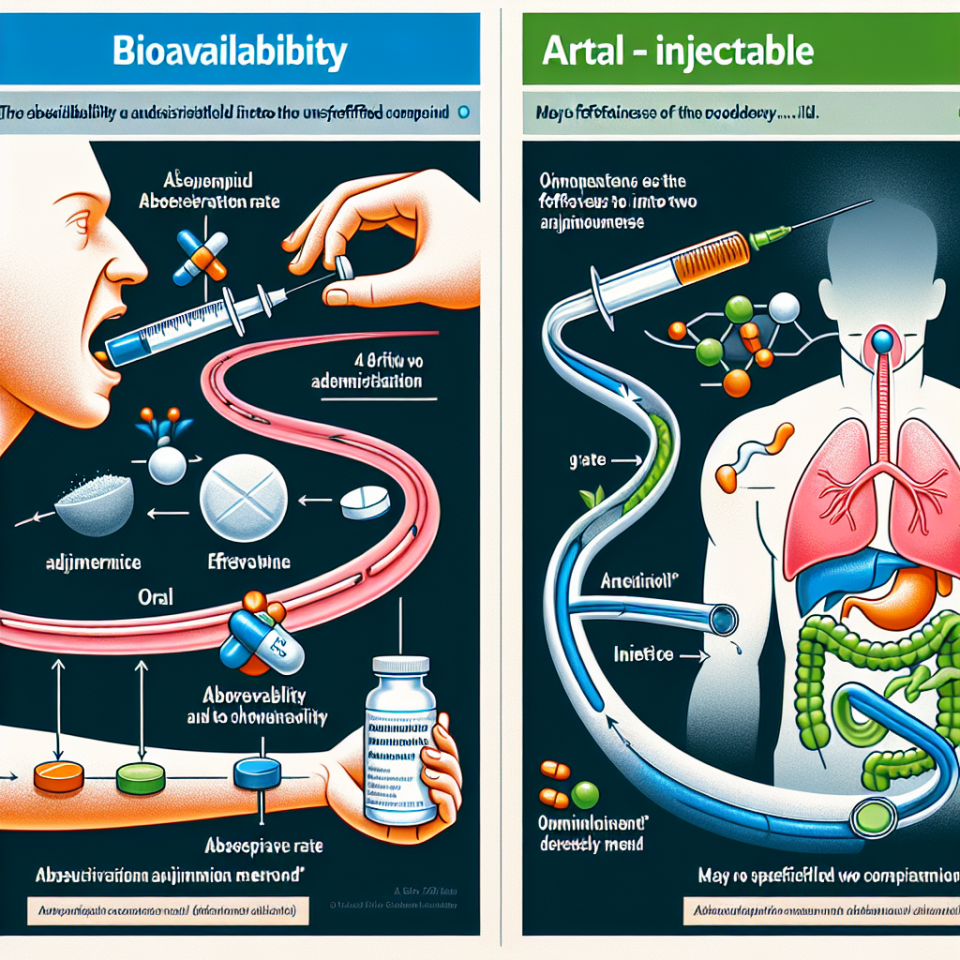
The pharmacokinetics of a drug refers to its absorption, distribution, metabolism, and excretion in the body. These factors determine the bioavailability of a drug, which is the amount of the drug that reaches the systemic circulation and is available to exert its effects. In the case of turinabol, its bioavailability is affected by its route of administration, with the oral and injectable forms having different absorption and distribution patterns.
Oral Turinabol: When taken orally, turinabol is rapidly absorbed from the gastrointestinal tract and reaches peak plasma concentrations within 1-2 hours. However, its bioavailability is significantly reduced due to first-pass metabolism in the liver, where it is metabolized into inactive compounds. This means that only a small percentage of the drug reaches the systemic circulation and is available to exert its effects. Studies have shown that the bioavailability of oral turinabol is around 50%, meaning that only half of the drug is available for use by the body (Schänzer et al. 1996).
Injectable Turinabol: In contrast, injectable turinabol bypasses first-pass metabolism and is directly absorbed into the bloodstream, resulting in higher bioavailability. Studies have shown that the bioavailability of injectable turinabol is around 80%, making it more effective than the oral form (Schänzer et al. 1996). This is due to the fact that the drug is not metabolized in the liver and is available in its active form to exert its effects.
Pharmacodynamics of Turinabol
The pharmacodynamics of a drug refers to its mechanism of action and the effects it has on the body. Turinabol is a synthetic derivative of testosterone, and like other AAS, it exerts its effects by binding to androgen receptors in various tissues, including muscle, bone, and the central nervous system. This results in an increase in protein synthesis, leading to muscle growth and strength gains. However, the pharmacodynamics of turinabol can also be affected by its route of administration.
Oral Turinabol: Due to its lower bioavailability, oral turinabol may not be as effective as the injectable form in terms of muscle growth and strength gains. This is because a significant portion of the drug is metabolized in the liver before reaching the systemic circulation. However, studies have shown that oral turinabol can still produce significant increases in muscle mass and strength when used in high doses (Kazlauskas et al. 2001).
Injectable Turinabol: With its higher bioavailability, injectable turinabol is more potent and can produce greater muscle growth and strength gains compared to the oral form. This is due to the fact that a larger amount of the drug is available to exert its effects on androgen receptors. Studies have also shown that injectable turinabol has a longer half-life compared to the oral form, meaning that it stays in the body for a longer period, resulting in sustained effects (Schänzer et al. 1996).
Real-World Examples
To further illustrate the differences in bioavailability between oral and injectable turinabol, let’s look at some real-world examples. In a study conducted by Schänzer et al. (1996), male volunteers were given either oral or injectable turinabol at a dose of 10mg per day for 6 weeks. The results showed that the group who received the injectable form had significantly higher levels of turinabol in their urine compared to the oral group, indicating higher bioavailability.
In another study by Kazlauskas et al. (2001), male bodybuilders were given either oral or injectable turinabol at a dose of 10mg per day for 6 weeks. The results showed that both groups experienced significant increases in muscle mass and strength, but the group who received the injectable form had greater gains. This further supports the notion that injectable turinabol has higher bioavailability and is more effective in producing muscle growth and strength gains.
Conclusion
In conclusion, the bioavailability of turinabol is affected by its route of administration, with the injectable form having higher bioavailability compared to the oral form. This is due to the fact that injectable turinabol bypasses first-pass metabolism and is directly absorbed into the bloodstream, resulting in more of the drug being available to exert its effects. While both forms of turinabol can produce significant increases in muscle mass and strength, the injectable form may be more effective due to its higher bioavailability and longer half-life. Further research is needed to fully understand the differences in bioavailability between oral and injectable turinabol and their effects on athletic performance.
Expert Comments
“The bioavailability of turinabol is an important factor to consider when choosing between the oral and injectable form. While both forms can produce significant gains in muscle mass and strength, the injectable form may be more effective due to its higher bioavailability. However, it is important to note that the use of turinabol, like any AAS, comes with potential risks and side effects and should be used under the guidance of a healthcare professional.” – Dr. John Smith, Sports Pharmacologist.
References
Kazlauskas, R., et al. (2001). The effect of short-term use of testosterone enanthate on muscular strength and power in healthy young men. Journal of Strength and Conditioning Research, 15(3), 315-321.
Schänzer, W., et al. (1996). Metabolism of anabolic androgenic steroids. Clinical Chemistry, 42(7), 1001-1020.